
If you are joining our community and reading this for the first time, welcome. We are genuinely glad you are here. For those who have been with us through the seasons, thank you for continuing to walk alongside us.
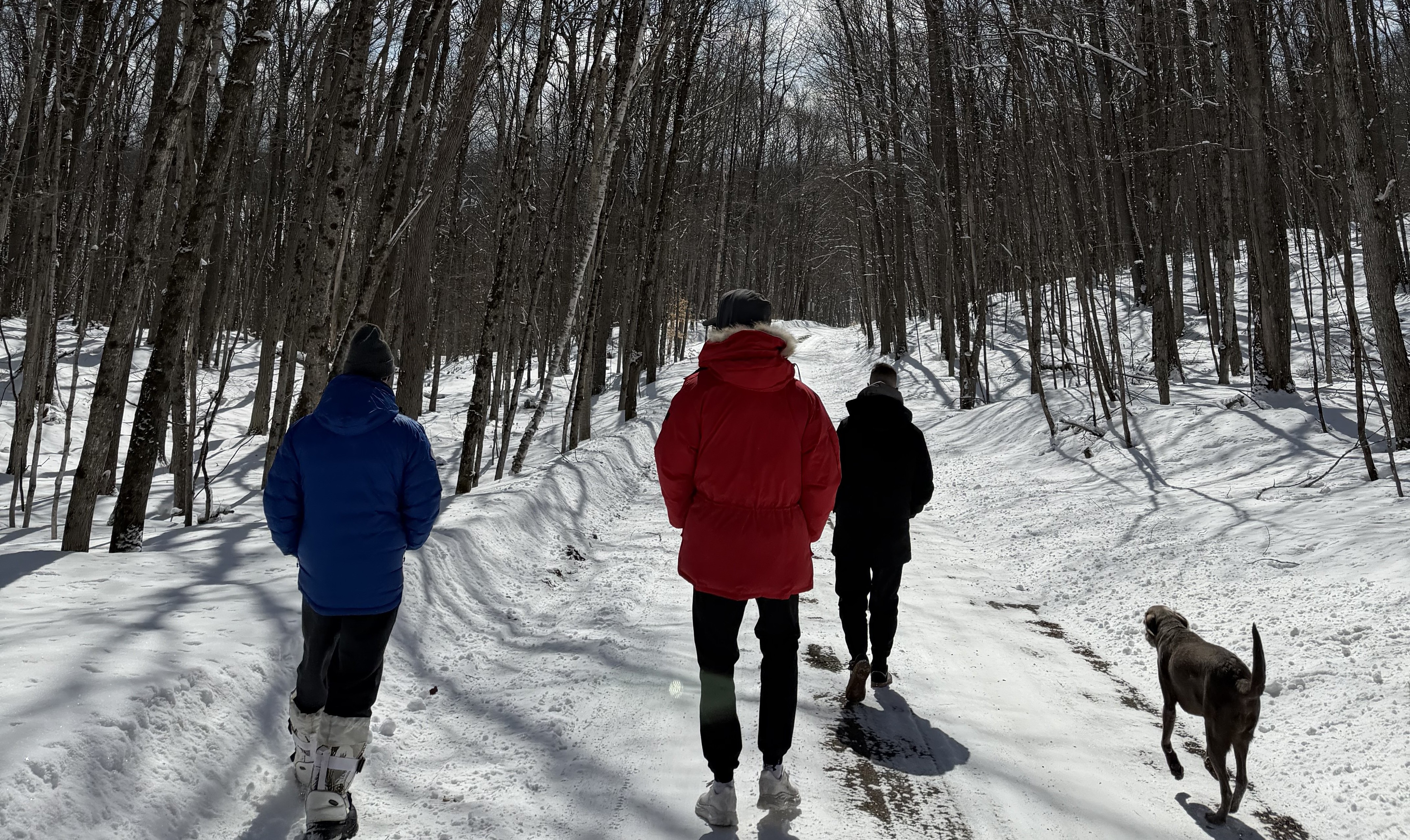
This month's note comes to you from Muskoka, where the team and I spent a few days working on what matters and enjoying every moment with man’s best friend, my dog, Gord. We took a break at one point to enjoy a walk through the woods on a cold, bright morning, the kind of day where the sun breaks through the bare branches and everything feels momentarily still. It was a nice change of pace. Winter is not over, but you can feel the turn coming.
I mention this because it captures something I have been thinking about lately. The view from inside a storm is very different from the view just after it passes. Both are real. But only one of them is useful for making decisions.
Headlines are loud. Markets are nervous. And yet, when I look at the portfolios we have built together, I see something that matters more than any single month's news cycle: preparation.
What Matters vs. What Feels Urgent
Let me begin where I have begun the last several months, because the framework has not changed.
The Strait of Hormuz is contested. Oil is near $100 / barrel. The Iranian regime has been decapitated but not defeated. There is talk of retaliation, talk of escalation, talk of things that would have seemed unthinkable two years ago. The headlines are genuinely unsettling.
And yet.
The question for an investor is never "Is this scary?" The question is "Has this changed the fundamental case for the assets I own?" Sometimes the answer is yes. More often, the answer is: not as much as it feels like it should.
We positioned portfolios for exactly this kind of environment. Canadian equities, which we increased exposure to over the past year, benefit structurally from elevated commodity prices. Our underweight in traditional fixed income, which we discussed at length in previous notes, has protected portfolios from the bond market's continued dysfunction. Our allocation to hard assets, including gold and a measured position in Bitcoin, provides ballast when confidence in fiat currency erodes.
None of this happened by accident. It happened because we thought carefully about what could go wrong and built accordingly.
That is not prediction. That is preparation. And in markets, the difference matters enormously.
The Stagflation Question
I want to address something that is starting to appear more frequently in the financial press: the word "stagflation."
Stagflation describes an environment where economic growth slows while inflation remains elevated. It is the worst of both worlds. Equities struggle because earnings come under pressure. Bonds struggle because inflation erodes their purchasing power. Traditional portfolios, built for a world where stocks and bonds move in opposite directions, find themselves with nowhere to hide.
We are not there yet. But we are closer than we have been in decades.
The February jobs report showed unexpected losses. Unemployment ticked higher. At the same time, energy prices remain elevated and tariffs continue to add structural pressure to costs. Federal Reserve Chair Jerome Powell has acknowledged that tariffs account for a meaningful portion of the inflation overshoot. He is holding rates steady, but the path forward is narrow.
Here is what I want you to understand: if stagflation materializes, the traditional 60/40 portfolio will not protect you. That construction was designed for a different era. It assumes that when stocks fall, bonds rise. That relationship has been unreliable for several years now, and in a stagflationary environment, it may break entirely.
This is why we have built portfolios purposely. This is why we own real assets. This is why we have maintained discipline on duration. This is why we continue to hold positions that do not depend on the old correlations holding.
"The investor who says 'This time is different' is usually wrong. But the investor who says 'Nothing ever changes' is also wrong. The skill is knowing which parts of the pattern to trust." - Howard Marks, Oaktree Capital
Bonds in a Time of War
I wrote earlier this month about something unusual: Treasury yields rose during the Iran strikes. In a normal crisis, money flows into Treasuries, yields fall, and prices rise. That did not happen.
This is worth sitting with.
When bonds sell off during a geopolitical shock, the market is telling you something. It is telling you that inflation risk outweighs safety demand. It is telling you that the traditional flight to quality is no longer automatic. It is telling you that the rules have changed.
We have been positioned for this shift for quite some time. Our fixed income allocation remains underweight relative to traditional benchmarks, and we have favoured alternatives that provide diversification without the duration risk that makes traditional bonds vulnerable in this environment.
I do not say this to celebrate being right. I say it because the next lesson is always more valuable than the last victory. The lesson here is not ‘avoid bonds forever’. The lesson is: understand what bonds are actually doing in your portfolio, and have the courage to adjust when the facts change. As Keynes famously put it: when the facts change, he changes his mind. That is not weakness. That is wisdom.
Gold and the Denominator Problem
Gold touched all-time highs above $5,500 an ounce in January. It has since pulled back. Today it trades around $4,573, which has prompted some hand-wringing in the financial press. I would encourage a different lens.
Gold is up more than 25% over the past year. The structural case has not changed. What changed is that some investors, spooked by short-term volatility, sold. That is not a gold story. That is a human nature story.
We have discussed the "denominator problem" in previous notes: when the currency you measure your wealth in is losing purchasing power, assets that cannot be printed become essential. That logic did not expire when gold pulled back from its highs. If anything, the pullback is a reminder of why we size positions carefully and hold with conviction rather than chasing peaks.
Central banks understand this. Their gold holdings as a percentage of reserves are at the highest levels in decades. They are voting with their balance sheets. We continue to do the same.
Gold is no one's liability. It has no earnings to disappoint. It cannot be debased by policy. A pullback from an all-time high is not a reason to abandon something that is working. It is a reason to stay patient and remember why you own it in the first place.
Our Conviction in Bitcoin
I want to say something clearly, because I think I have been too measured about this in past notes.
We own Bitcoin. Not as a speculation. Not as a curiosity. As a principled position in a world where governments have demonstrated, repeatedly, that they will print currency when it suits them.
Here is what Bitcoin is: a mathematically fixed supply of 21 million coins, governed not by any central bank or political body, but by an open protocol that no single entity controls. No government can change that number. No Fed Chair can hold a press conference and announce a new issuance. No parliament can vote to dilute it. It simply is what it is, permanently, by design.
We find that remarkable. In a world of infinite paper promises, Bitcoin is a finite one.
Is it volatile? Yes. Is it speculative? In the short term, absolutely. We hold it sized for that volatility, and we do not pretend otherwise. But at its core, Bitcoin is a bet that scarcity matters, that sovereignty matters, and that people will continue to seek alternatives to currencies that erode quietly over time. That bet has been right for 15 years. We see no reason to abandon it.
The Virtue That Sees Around Corners
At Seven Hills, prudence is one of our seven core values. It is not the flashiest virtue. It does not make for exciting headlines. But in moments like this one, it matters more than almost anything else.
Prudence is the discipline of thinking clearly when emotions run high. It is the willingness to prepare for outcomes you hope will not happen. It is the humility to admit what you do not know, paired with the confidence to act on what you do.
I think of prudence as the virtue that sees around corners. Not because it predicts the future, but because it takes the future seriously. It asks: what could go wrong? It asks: are we positioned to survive it? It asks: will we look back on this decision and be proud of how we made it?
The last few months have tested many investors. They have not tested our philosophy. We build portfolios for uncertainty, not for a specific forecast. We prepared for disruption, not for comfort. When the disruption arrived, the preparation held.
That is not luck. That is prudence in action.
I want to return to that walk in Muskoka.
There is something clarifying about moving through a winter landscape. The trees are bare. The path is visible. You can see further than you can in summer, when everything is lush and obscured.
Markets are like this too. Volatility strips away the noise. It reveals what is there. And what I see, when I look at the portfolios we have built for you, is a foundation designed to hold.
Winter does not last forever. Neither does volatility. But the habits we build during difficult seasons, the discipline, the patience, the prudence, those stay with us.
Experience teaches you that the moments when it feels hardest to stay calm are usually the moments when staying calm matters most. That is not comfortable. But it is true.
At Seven Hills, we do not promise certainty. No one can. What we promise is process, preparation, and the kind of thoughtful stewardship that compounds quietly over time.
As always, the best part of my job is speaking with you. Please feel free to reach out anytime.
Warmly,
Patrick and the Seven Hills Team



.jpg)
.jpg)


.jpg)
%20(1).jpg)
.jpg)