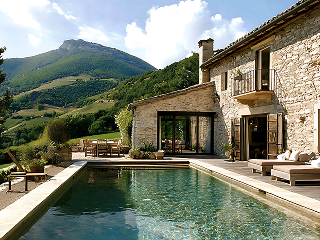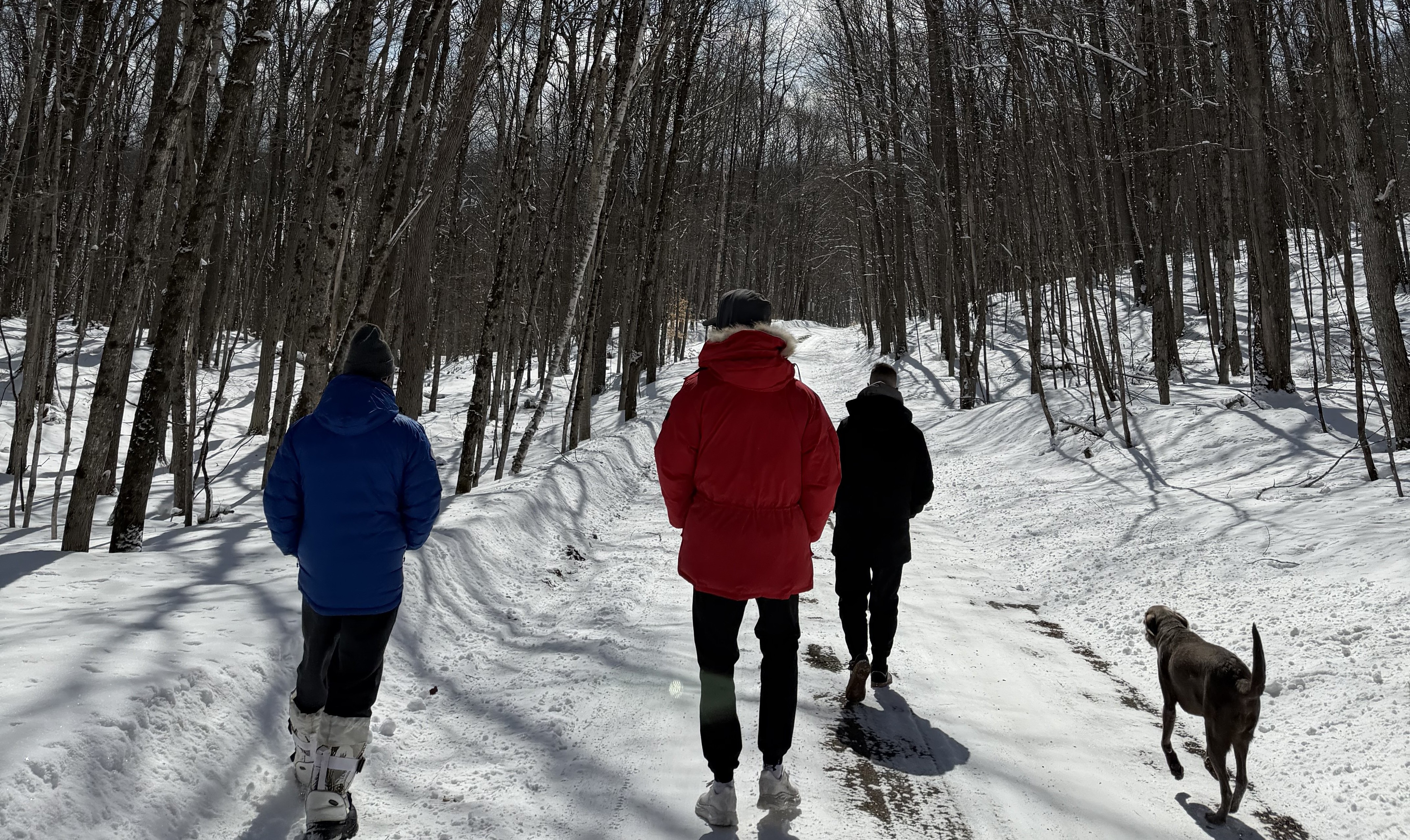
Last week the six of us gathered where we regularly do, at my home in Muskoka.
We have done this often enough over the years that many of you know the rhythm of it. Usually we bring a long agenda, the kind that tries to boil the ocean before lunch. This time the agenda had exactly one item. We were going up to talk about you, our clients, and nothing else. That is what we did, for two days.
We went through our client families one by one, and we did it for real reasons. Some of our newer team members have not yet met all of you, and we wanted them to know you, not as names on an account but as people with lives and plans. And for every family we asked ourselves the harder questions: Have we truly understood what this person needs? Have we made sure they know everything we are able to do for them? Is there a gap somewhere that we have not yet closed? Two days went by that way, and it was the most useful time we have spent together in a long while.
On the first evening we did stop, in the last hour before sundown, and went out on the water. Five of us were eager, practically willing a fish into the boat. The sixth, I will only say she was politely indifferent to the entire exercise, came along to be a good sport. You already know how this ends. She was the only one who caught anything. The rest of us reeled in nothing but our own enthusiasm. I also managed to donate my smart glasses to the bottom of the lake, the pair I wear every day to take my calls. They turned out to be less smart than advertised, though in fairness, so did the man wearing them.
On the drive back I kept turning one thought over. Every person on that team came to Seven Hills from somewhere else. Different firms, different cities, different stages of life. The only reason the six of us were together at all is you.
I have worked in this business for 35 years, in two countries, at some very good firms. I have never enjoyed it more than I do right now. Not because the world is calm. It is anything but. It is because I get to do this work alongside people who care about it as much as I do, on a road we chose for ourselves.
There is a great deal happening in the world this month, and some of it is heavy. We are going to walk through it together, honestly and without drama, and I will tell you how we are thinking about it and what we are doing with your money. But the right place to begin is where we began, at home in Muskoka, with your names in the room.
Before we turn to the world, a few words about home.
If you read the opening, you know the six of us spent two days in Muskoka talking about nothing but you. That number has grown this year, and it has grown for one reason. Over the last several months we have added two people to our client service team. Many of you already know Cassie, and Cristian has now joined her there. We did that because our business is growing and, more to the point, your needs are growing, and we want to stay well ahead of them.
Cristian joined us barely a week and a half ago. At the retreat I noticed he carries “Philippians 4:8” on his arm. The passage is about fixing your mind on what is true, noble, right, pure, and lovely. I would put it more plainly: focus on what matters and know the difference between what matters and what does not. That is the whole of how we try to work. I did not know that about him when we hired him. I found out days into the job, which is rather the point. We did not teach him that. He arrived with it.
Growth is only worth mentioning if it changes something for you, so here is one change you will notice:
One email for anything. We have set up a single address, serviceteam@sevenhillscapital.ca, that reaches the whole team at once. When you are not sure who to ask, or you simply want the fastest answer, send it there. When in doubt, send it there. Nothing will fall through the cracks.
None of this is meant as an announcement for its own sake. It exists to make us easier to reach and better to work with. That is the only kind of growth we are interested in.
A political scientist I follow closely, Robert Pape at the University of Chicago, said something in a briefing last week that stayed with me. Financial planners, he said, are generally not experts in war and geopolitics, so his audience should take his analysis to their advisors. He is right about the first part. The second part is the reason this section exists. You should not have to do that work yourself.
Most of what you will read in North American news this month tells a version of the same story: a deal with Iran is close, the Strait of Hormuz is reopening, and the worst is behind us. I hope that proves true. But several things are happening at once, and together they matter more than any one of them alone.
The war has not ended. It has moved. The war with Iran, which the United States and Israel began at the end of February, is now in its seventh month. A ceasefire agreed in June did not hold. In early September the pressure shifted south and west. Within about a day of each other, drones launched from Iraq struck the pipeline Saudi Arabia had been using to move oil around Hormuz, and the kingdom shut it down. At almost the same moment, Yemen's Houthis completed their takeover of the coastline along the Bab al-Mandab, the narrow strait at the bottom of the Red Sea, including the small island that sits in its middle. The world's two most important oil chokepoints are now under pressure at the same time.
The cost has been larger than most people realize. The Pentagon's own inspector general reported in mid-September that Iranian strikes damaged or destroyed hundreds of buildings at American bases across eight countries, including the Navy's regional hub in Bahrain. Resupply now runs through a small island in the Indian Ocean, stretching each cycle to two weeks or more. The report also acknowledged shortfalls in advanced munitions. The official cost estimate of US$33.4B through June does not yet include rebuilding any of it. Whether those bases are rebuilt at all, or whether America gradually steps back from a region it has anchored for decades, is one of the most important open questions of the next few years.
Both sides are watching the calendar. At the UN last week, President Trump described his choice as a deal or annihilation, and predicted a deal right after the midterms because, in his words, Iran is waiting to see how he does. The next day, Iran's president answered from the same podium: the region's security is shared, or everyone lives with insecurity together. When both sides treat the same date as a deadline, the weeks around it become the most delicate stretch of the conflict. Nobody has to want a wider war for one to happen. It only takes both sides being unwilling to blink first.
I make a point of watching the UN speeches each September, and I sat through as many as I could again this year. I do it for the same reason I invest the way I do. I would rather go to the primary source than take the version that reaches me secondhand. Most of these speeches get almost no coverage, and what little there is tends to be shaped before it arrives. Hearing world leaders in their own words tells you more than any summary of them will. At the end of a day I would rather spend twenty minutes with the real thing than an hour with someone telling me what to think about it.
The number that isn't on the sign. Charlie Garcia, a former intelligence officer whose writing I read closely, pointed out something this month that I have not been able to shake. Every gas station lights up its gasoline price in large numbers you can read from the road. Diesel gets a smaller line, often around the side. Yet you pay for diesel in nearly everything you buy: groceries, lumber, the truck that delivers the box, the train that carries the parts. Diesel averaged US$6.53 a gallon in the United States last week, the highest in the EIA's records and US$2.78 more than a year ago. The American emergency oil reserve has fallen to 285 million barrels, its lowest since 1982, roughly two weeks of consumption. The Federal Reserve raised rates in September for the first time since 2023, but a rate hike cannot refine a gallon of fuel. This is inflation with a physical cause, and what happens in a strait most of us could not find on a map shows up at the grocery store.
President Xi is playing a longer game. China's leader made his first state visit to Washington in over a decade last week. There were three days of ceremony, an extension of the trade truce, and very few concrete agreements. To understand how he negotiates, it helps to know where he comes from. As a boy, Xi Jinping was the son of a senior party official, until his father was purged and the family fell from grace. At fifteen he was sent from Beijing to a poor village in the countryside, where for years he lived in a cave dwelling carved into a hillside, slept on a brick bed, and hauled coal and dug ditches alongside the villagers. He applied to join the Communist Party and was rejected again and again, by some accounts nearly ten times, before he was finally accepted. A man who spent seven years learning that patience is a form of power does not negotiate on a quarterly calendar. That matters now for a concrete reason: China controls most of the world's supply of the rare earth magnets needed to rebuild the very weapons stockpiles this war has depleted, and new sources elsewhere are years away. America holds real leverage of its own, in farm exports and advanced chips. But one side is counting in election cycles and the other in decades, and that difference is the whole game.
Canada is not waiting to be rescued. Closer to home, trade talks with the United States collapsed in mid-August. The next day the US imposed 50% duties on $28B of Canadian goods, and Canada responded in kind. What has happened since is the part worth noticing. Rather than absorb the blow and hope for a change of heart in Washington, Prime Minister Carney has moved quickly to widen Canada's options. In mid-September his government hosted the first-ever Canada Investment Summit, right here in Toronto, drawing investors from nearly 30 countries who together manage more than $100 trillion, and it reports the summit unlocked close to $500B in new investment commitments. Canada is now the only non-European country admitted to Europe's joint defence procurement program. And on September 16, Carney became the first sitting Canadian prime minister to attend the European Union's State of the Union address, where the EU's president invited Canada to become the first "associate member" in the bloc's history. Turning commitments into signed deals is the work ahead, and Ottawa knows it. But the direction is clear, and it is the right one: a smaller country, dealt a genuinely difficult hand, choosing to build rather than to brood. In an interview with the New York Times last week, Carney said that leaders have a responsibility to plan for even the most extreme risks, and called it simply risk management.
That phrase is worth borrowing. It is also our job.
Everything above is real, and none of it is a reason to act in a hurry.
We read the news closely so that you do not have to carry it around with you. But we hold to one rule in months like this: we do not trade fear. Fear is loud, and it always feels urgent. It rarely tells you anything useful about money you will need in 10 or 20 years.
What matters is quieter. Whether your plan still fits your life. Whether your portfolio is built to bend without breaking. Whether we own things that produce real cash flow, from businesses and resources the world cannot do without, no matter what the headlines say this week. We asked ourselves those questions again this month, and the answers did not change because the news did.
Nobody, including us, knows how the next few months unfold. What we can do is make sure your money is positioned so that you do not need to know. That is the lens for the rest of this note.
I want to talk about Berkshire Hathaway, not that there needs to be a reason to. It has lagged the broader market since we bought it, and waiting on something that is not moving is uncomfortable. I feel it too. So here is how we think about it, and where I would welcome your pushback.
At Seven Hills we wear two hats. Some of what we do is trading, adjusting our weights as conditions change. The rest is investing, owning good things for the long haul. Berkshire sits firmly under the second hat. But the story of why we own it starts under the first one, with technology.
We are believers in technology, and we will always own it. That is not in question. The only question is ever whether we are overweight or underweight. For several years we carried an overweight position, and it served us well. But technology's rise had carried it well above its long-term average, and reversion to the mean is a real part of how markets work.
Torsten Slok, the chief economist at Apollo, put his finger on it this week. The analysts who cover technology expect the sector's cash flow to more than double by 2028, an increase of over US$1.2 trillion. The analysts who cover technology's customers, the rest of the market, expect those companies to add far less. "Both cannot be right at the same time," he wrote. In other words, a great deal is priced in, with little room for anything to arrive late.
Expecting some gradual return toward the long-term average, and not wanting to give back gains we had already earned, we trimmed our technology weighting back toward normal. That is the trader's hat doing its job. Not falling in love, not running away, just right-sizing.
Trimming technology, though, is not the same as leaving the US market. We protect capital, we do not make dramatic bets like abandoning stocks altogether. So the real question became where to put that money while staying invested. Berkshire answered it on every front at once.
We bought it first for what it is: a superb operator with a decades-long track record, run by people we trust, and a collection of real businesses we are glad to own. A major railroad. One of the country's largest energy utilities. A large insurance operation. Dozens of manufacturing and retail companies. Energy, in fact, runs through Berkshire from top to bottom, the regulated utility, the railroad that moves the nation's goods and fuel, and major stakes in two large oil producers, one of which Berkshire owns more than a quarter of outright. As we were turning more constructive on energy late last year, that suited us well.
There was also a quieter comfort. When we trimmed technology, we did not lose it. Berkshire's single largest holding is Apple, and it owns Alphabet as well, so we kept real exposure to the very companies we had lightened. If technology kept climbing, we still owned some of it through the back door. If it cooled, we were better balanced. Protection working in both directions.
And then the kicker: the cash. At the end of June, Berkshire held US$365.5B in cash and short-term Treasuries, more than the entire market value of Canada's largest bank. That money is not idle. Berkshire is among the first firms a company in distress calls, which gives it the first shot at structuring deals on excellent terms, and it has a long record of only doing the ones that make sense. In the fall of 2008, when Wall Street was starved for capital, Berkshire put US$5B into Goldman Sachs on terms that paid 10% a year plus the right to buy shares cheaply later. It has made opportunistic moves in calmer times too. Its Apple stake, begun in 2016, grew into one of the most profitable investments in its history. The pattern holds: Berkshire has money when others need it, and it gets paid well for that.
We would rather have that optionality, in those hands, than sit on cash ourselves and miss the market while we wait.
Patience is rarely rewarded on a schedule, and I am comfortable with that trade. If you see it differently, please call me. That is exactly the kind of conversation I enjoy most.
Berkshire is one kind of long-term holding. Gold and Bitcoin are another, and they belong to the same discipline: things we own with conviction, for years, and do not trade in and out of.
Gold. We hold gold for reasons as old as money itself. When currencies are devalued, and they are being devalued, wealth held purely in paper quietly loses ground. Add ordinary inflation on top of that, and the picture for money left sitting in cash is not a happy one. Over long stretches, only two things have reliably kept pace with inflation: equities and gold. Gold is scarce, it is real, and it has outlasted and outheld virtually every currency ever printed. And the institutions that print those currencies are themselves buying it, at a remarkable pace. Central banks bought more than 1,000 tonnes of gold a year from 2022 through 2024, and another 863 tonnes in 2025, still close to double their average from 2010 to 2021. By the world's most-watched survey, more of them plan to keep adding than at any point on record. When the issuers of paper money are quietly trading it for metal, it is worth paying attention.
Bitcoin. We invested in Bitcoin years before most banks and platforms would allow their clients anywhere near it. That is what being independent lets us do: act on conviction without waiting for permission from an institution. And the story since then is one of a slow, steady change in standing. Bitcoin has gone from something viewed with deep skepticism, dismissed as a curiosity or worse, to something increasingly foundational. It is part of the conversation now, part of the landscape. Consider that BlackRock's Bitcoin fund alone now holds more than US$65B. That is not fringe money. That is the financial establishment quietly building Bitcoin into the plumbing. BlackRock is now designing model portfolios, the templates advisors everywhere build from, that hold Bitcoin alongside ordinary stocks and bonds. The technology that was supposed to live at the edges is being wired into the center.
Bitcoin is off its highs today, but step back and look at what it has done over the last several years. We never owned it for the month. Like gold, it is a long-term core position, held for what it is and what it is becoming, not for where it trades this week.
That is the thread running through all three, Berkshire, gold, and Bitcoin. None of them is a trade. Each is something we studied, believed in, often earlier than most, and chose to own with patience. The headlines will do what headlines do. These positions are built to be held straight through them.
This month I have been rereading a book that has stayed with me, The Fourth Turning Is Here by Neil Howe. Howe is a historian and economist, Yale-trained, who has spent his career studying the long rhythms of history. It is not a book about markets. It is a book about hope, though you have to read it a certain way to see that.
Howe's argument is that history moves in long cycles, roughly the length of a human life, and that each one passes through seasons much as a year does. We are now, by his reckoning, in the hardest season, the winter, a period of crisis when old institutions strain and break. That part is not hard to believe this month. But here is the piece worth holding onto: In Howe's telling, winter is not the end of the story. It is the passage that comes right before spring.
Look back at the winters that came before. One began with the Great Depression and ran through the Second World War, and what followed it was the longest boom and the broadest prosperity the modern world had ever seen. Before that, the Civil War, and then decades of expansion. Before that, the Revolution, and the founding of a country. Each was frightening to live through. Each gave way to rebuilding, confidence, and a new beginning that the people in the thick of the crisis could scarcely have imagined.
That is the thought I keep returning to. It is entirely possible that we are living through one of those passages right now, and that we simply cannot see it yet. These turning points rarely announce themselves. They become clear only in hindsight, when a later generation looks back and understands what was being born while everyone alive at the time could see only what was falling apart. If Howe is right, the noise and difficulty of this moment are not signs that things are ending. They are the labour before something better arrives, the last hard stretch of winter before the first green of spring. And there is real reason to think the spring could be a good one, with new technology and a rising generation ready to build.
I find that genuinely reassuring, and I offer it to you in the same spirit. Not as a prediction, and not to wave away how heavy the world feels right now, but as perspective. We have been here before, more than once, and every time, the people who came through it well were the ones who kept faith in the future and stayed standing long enough to see it arrive.
That is how we are holding your money. As it happens, it is good counsel for your health as well.
When the world gets loud, the first things to slip are usually the most important ones. Sleep gets shorter. Meals get quicker. The walk gets skipped. And the people we love can end up with less of our attention than we mean to give them.
We have written before that health, like wealth, is built on a foundation: sleep, nutrition, exercise, and relationships. No pill or treatment matches getting those four right. In a month like this one, the fourth deserves particular attention.
The Harvard Study of Adult Development has followed the same group of people, and later their children, since 1938, making it one of the longest studies of adult life ever conducted. Its most consistent finding surprised even the researchers running it. The best predictor of who would be healthy and happy in their 80s was not cholesterol, income, or career success. It was the quality of their relationships in their 50s. The people who felt most connected lived longer, and lived better.
That is easy to agree with and harder to live when the headlines are shouting. We all feel the pull to check one more update instead of returning the call we have been meaning to make. But the news will still be there in an hour. The long dinner, the unhurried call, the evening outside with no screen in sight: those compound too, in ways no portfolio can.
We just passed into fall, and this note follows the first full harvest moon of the season. I had the chance to watch it rise over Lake Ontario, which, whatever anyone in Washington may have decided to call it lately, is still Lake Ontario to those of us who live beside it. One of my closest friends was married beneath it. A group of us who met at university years ago were together again that night, and I felt the kind of connection this whole section is about. The moon was bright enough to lay a path of light across the water, and I came away grateful, and fortunate, to have people like that in my life. It is a small reminder that the things worth showing up for, the people and the moments, do not wait for a quieter time to arrive.
This letter reaches you on September 30, the National Day for Truth and Reconciliation.
I will not pretend to speak for anyone else's history on this day. What I can say is that the day asks something of all of us that is harder than it sounds: to look honestly at what happened, to listen more than we speak, and to accept that understanding comes slowly and is never finished. Truth first. Then, with patience, the work of making things right.
Last week, the President of Finland, Alexander Stubb, stood before the United Nations and described the moment we are living in as a choice between co-operation and conflict. He opened by borrowing a line from Kofi Annan: "Whatever our differences, we stand or fall together." In a month full of loud voices, his was the one that stayed with me, because it was spoken with humility and it pointed at what matters.
That is the thread through everything in these pages. The world is going through a hard season, and we will not pretend otherwise. But hard seasons are where honesty gets tested, and where the things worth keeping show themselves. Relationships. Patience. Owning what is real. Telling the truth, even when it is uncomfortable, and then doing the steady work that follows.
The fireworks come before the joy. We intend to be standing beside you for both.
As always, the best part of my job is speaking with you. Please feel free to reach out anytime.
Warmly,
Patrick Keeley
Seven Hills Capital Corp.
2 St. Clair Avenue W. | Toronto | Canada
Wealth is not just about what you have, but how you live.
This material is for informational purposes only and should not be construed as investment advice or a recommendation to buy or sell any security. Past performance is not indicative of future results. Please consult with your Seven Hills advisor before making investment decisions.
The cover painting is the work of James Lahey,shared with his kind permission