The lake turned last week.
As most of you know, I divide my time between Toronto and Muskoka, and one of the things I have come to notice about living part of my life around water is that the seasons announce themselves there before the calendar does. Anyone who spends time on a lake will know what I mean. It happens every year, and it always feels sudden. The sun is still bright, but there is a coolness underneath it, and you reach for a sweatshirt to sit outside. The water seems to go a shade darker, the way it does when it starts keeping its heat to itself. The sunsets, which spent July finishing in the eights and nines, now do their work in the sevens. And at the local store, every conversation opens the same way: Can you believe how fast summer went?
I understand the mourning. A Canadian summer is really only eight weeks long, and we ask those eight weeks to hold a whole year of expectations. But I want to make the case this month that September is not an ending. It just plays one on television.
A few nights ago, I stayed up late to watch the lunar eclipse. It began as one of those flawless northern nights: not a cloud anywhere, the moon so bright you could have read by it. Then the Earth moved between the sun and the moon and began dragging its shadow across the surface. The light drained away until almost the entire face of the moon had disappeared into Earth's shadow. A full moon, after all, is only sunlight bouncing off stone. Put a planet in the path, and there is nothing left to bounce.
What I was not prepared for was the forest. The light I had been standing in was borrowed moonlight, and when it went, the darkness that arrived felt almost physical. Then the shadow slid off, the light returned, and the moon was exactly what it had been all along. Nothing about it had changed.
Only what was standing in front of it.
In July I wrote to you about that same moon glowing orange through wildfire smoke.
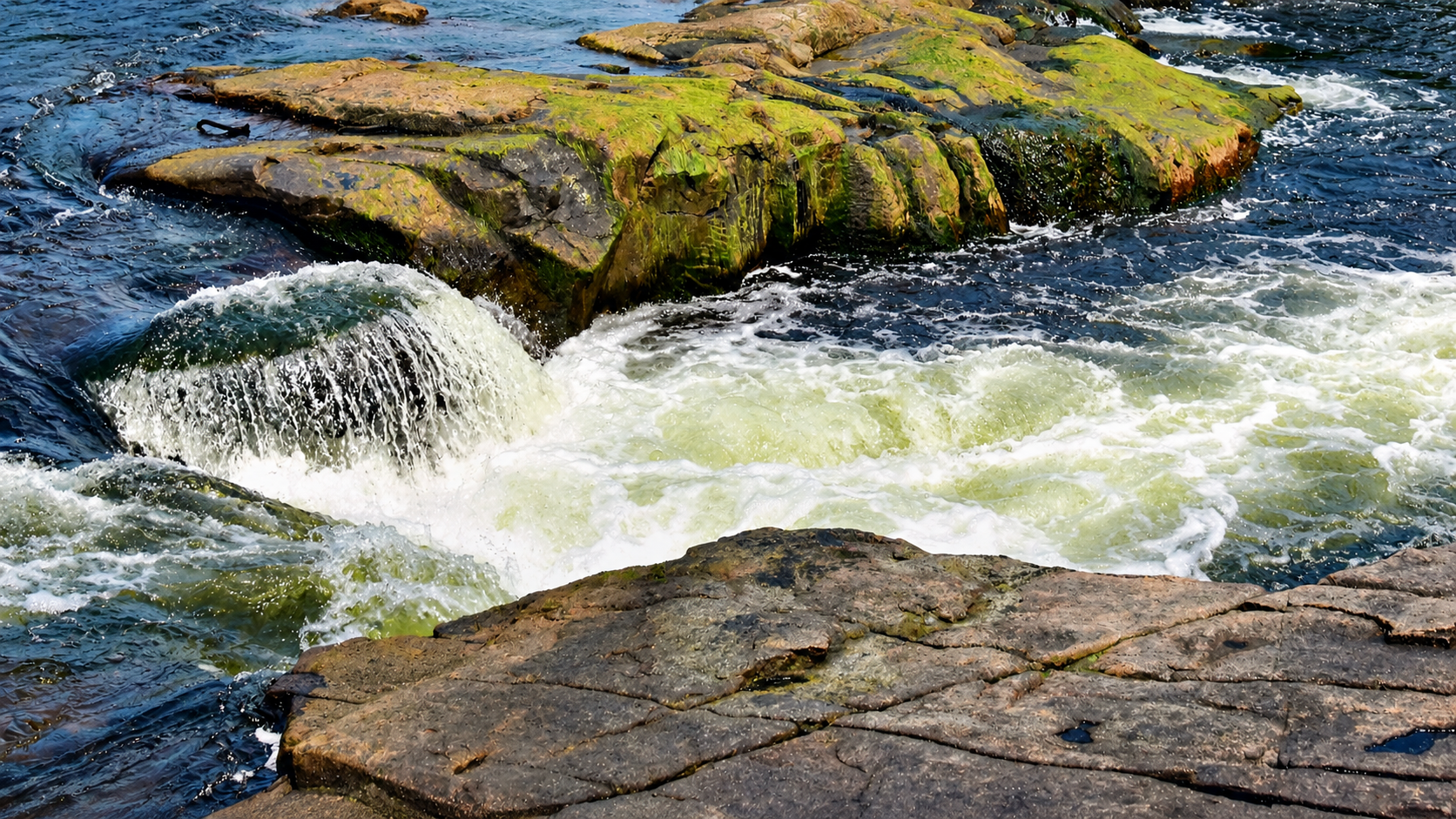
Last week I spent a couple of days on the French River, one of them fishing with my friend Mike. If you have never been, it is worth the drive. The river runs through ancient Canadian Shield, rock that glaciers spent thousands of years grinding and polishing, and the rock simply sits there: immovable and unbothered, making up the landscape.
There is remarkably little built there. What structures exist are mostly camps, scattered so thinly that you can run long stretches of water without seeing one. Many draw power from solar panels because the grid simply does not reach them. Building on exposed granite presents its own problems, so people adapted to the land rather than expecting the land to accommodate them. They looked at what could not be changed and built differently around it.
Nobody out there has ever successfully argued with the rock.
I should tell you about the fishing, because the river handed me something I had been waiting for since I was a boy with a stick and a line. I have fished this part of the world my whole life, and in all those years two fish had escaped me entirely: the walleye and the muskie. That morning the first debt was settled. I brought in a twenty six inch walleye, the first of my life, and at the very moment I was landing mine, Mike hooked another the same size, the largest of his. Fishermen call it a double header. No matter your age, boys will be boys when it comes to catching fish. The smiles say it all.
.jpg)
A lifetime of casting, and the first one arrives in the same minute as somebody else's best one ever. You cannot schedule a morning like that. You can only keep showing up until it happens.
Later we ate a shore lunch on a vast slab of granite, the fish we had caught an hour earlier. What stopped me was the silence. No engine. No aircraft. No human sound anywhere.
Across from our rock, another slab of granite framed a deep pool, and the water between us was dark. The clouds were low that day, with rain coming and going. But every time the sun broke through, something large rose out of that pool and held just beneath the surface, and I could not tell what I was looking at. It never stayed long enough to point at, so for a while I kept it to myself. Then it happened often enough that I could point, and our guide, whose family has been on that river for generations, said it was most likely a muskie. The second of my two fish, showing itself without being caught.
The fish did not surface on demand. It surfaced when the light did. The river was not going to confirm anything, and I have decided I prefer it that way.
An eagle crossed overhead while we ate. A few steps away, blueberry bushes carried enough fruit to fill buckets, planted by no one. All that life, giving and thriving, entirely undisturbed and entirely unconcerned with the market. I have that thought every time I am in nature, and it has never once worn off.
The river is fast, loud, powerful, and gone downstream by the time you point at it. The rock is what remains. Water does shape rock, but over centuries, not over an afternoon, and never by shouting at it.
Every month, the job of this letter is the same: sort what happened into water and rock. Here is my attempt for August.
Bitcoin provided the month's clearest example of just how quickly the water can move. After a brutal stretch, it surged more than twenty percent in little more than a week, briefly climbed above $80,000, and put itself on track for its first positive August in five years. The interesting part was not that Bitcoin rallied. It was that nothing about Bitcoin had changed. There was no breakthrough, no new use, no adoption story that had not been there the week before. What changed was the world around it: a weaker U.S. dollar, intervention in the Treasury market, and a great many people positioned for the price to fall.
Bitcoin did not become twenty percent more useful in a week. The price of money moved, and the price of Bitcoin followed.
Everything runs through the price of money now. Remember that sentence.
Gold told a similar story. It climbed back above $4,600 an ounce during August, its strongest month since January, helped by debt concerns, a softer dollar and shifting expectations around interest rates. We own gold as ballast, because it does a job bonds are struggling to do. That is a very different thing from owning it because it is running, and the distinction matters more than the position does.
Oil told the most instructive story of all. When tanker traffic through the Strait of Hormuz was severely disrupted this spring, forecasts of dramatically higher oil prices were everywhere. Instead, prices eventually settled back into the eighties. And as an owner of energy companies, I will tell you something that sounds strange out loud: I am glad.
At $150 a barrel, oil stops being revenue and starts becoming demand destruction. It breaks the consumer, invites recession and eventually collapses under the weight of the damage it creates. With the barrel in the eighties, the producers we own generate enormous cash flow while the economy can still carry the cost. That is much closer to the line where the price is high enough to reward the patient and low enough to last.
It is worth understanding why prices are there, because the shortage was not imaginary. This spring, the 32 member countries of the International Energy Agency agreed to make 400 million barrels of emergency oil available to the market, the largest coordinated release in the agency's history. Consider what happened in the United States alone. Its Strategic Petroleum Reserve held about 415 million barrels in late February. By the end of July it had fallen to roughly 305 million, its lowest level in more than four decades. Roughly a quarter of America's emergency petroleum cushion disappeared in five months.
That cushion is one of the reasons the shock did not translate directly into the price at the pump. But a cushion cannot be used twice, and it does not refill quickly. If the conflict persists, the next disruption arrives with considerably less standing between it and the price you pay. That is not a forecast. It is an inventory of the protection that remains, which is usually a more useful thing to know.
And it says something larger about the world we invest in. The systems we depend on operate with remarkably little slack. Sometimes all it takes is a modest change in flow through one narrow waterway, and the entire calculation shifts.
If you want to see what this price level does closer to home, look west. Alberta entered this fiscal year forecasting a $9.4 billion deficit. Its latest update now forecasts a $2 billion surplus. An $11.4 billion swing in a matter of months, with most of the improvement coming from higher resource revenue. The same barrel that stings at the pump refills a provincial treasury. One price, rippling in both directions.
And quietly, without a parade, our longstanding tilt toward Canada keeps doing its work. The Canadian market has outperformed its American counterpart again this year, extending last year's lead. I raise this not to keep score between two countries. Many of us live and invest on both sides of that border, and we are stewards of both with equal conviction. The reason is composition, nothing more.
Think for a moment about what the great infrastructure buildout of this era actually requires. Datacentres get the headlines, but they are made of copper and steel and aluminum, powered by natural gas and uranium and hydroelectricity, and financed by somebody. A large share of those raw materials comes out of Canadian ground, produced and moved by Canadian companies, and the Canadian market leans toward exactly that: energy, materials and the institutions that finance them. Hard assets, scarcity and the lenders to both, which is precisely the neighbourhood we have wanted to own while inflation remains stubborn. The tilt is arithmetic, not patriotism. When the arithmetic changes, we will change with it.
Which brings me to bonds, and to the ballast question. For four decades, the classic sixty-forty portfolio benefited enormously from a world in which falling inflation and falling interest rates frequently allowed bonds to cushion equity declines. That environment has changed. With inflation proving stubborn and governments borrowing on a scale the world has rarely seen, the traditional case for lending your money for ten or thirty years deserves more scrutiny than it once did.
Could long rates fall from here? Certainly. This month showed how quickly. But notice what helped them fall: intervention, not an abundance of good news. We are not interested in building your safety net around the assumption that an asset's best days will arrive when somebody comes to rescue it. So we keep looking for ballast where the contract is clearer: hard assets, scarcity, cash flow, and businesses that do not need to borrow much to grow.
On artificial intelligence, I hold two views at once, and I believe both are right.
I am skeptical of the price. By that I mean the price of the stocks, and above all the speed at which they have risen. When anything attached to artificial intelligence appreciates that quickly, the price begins to reflect the excitement more than the earnings. The rush to build datacentres has become so intense that it is beginning to distort markets for memory, chips, electricity and infrastructure. Manufacturers have shifted capacity toward the specialized memory demanded by AI systems, tightening supply elsewhere and pushing up the cost of components used in ordinary electronics. There is a wonderful irony in that. The technology everyone promises will eventually be deflationary is, in parts of the economy today, creating inflation of its own.
But I am hopeful about the tool. AI will not ultimately be another tool we use. It will be inside the tools we already use. Imagine one brain you can reach that connects to the various systems in your life and does the coordinating for you, instead of you juggling a dozen applications that each promised to simplify something. That is where I believe this is heading. It is also why we still want to own the picks and shovels of this era at sensible prices, even as we decline to chase the frenzy.
Skeptical of the price. Hopeful about the technology. There is nothing inconsistent about holding both ideas at once.
Now for some seasonal trivia. September is, statistically, the worst month of the year for the S&P 500. Since 1950, it is the only calendar month with a negative average return, losing roughly 0.7 percent. I have been doing this for more than three decades, and it still amazes me how the market seems to change its personality when the calendar turns.
But look closely at that number. Seven tenths of one percent. The market can lose that before lunch on an ordinary Tuesday. As a trading signal, it is useless.
What I think is actually happening is simpler and more human. September is when attention comes back. The desks refill. The committees reconvene. An entire industry takes a hard look at what it owns and asks what really matters now. It does not take panic to move markets. It only takes millions of people making small changes at the margin at roughly the same time.
September is not the market's worst month.
It is the market's first day of school.
What feels urgent: a twenty percent move in Bitcoin, the worst month of the year arriving, headlines about interventions and eclipses.
What matters: the price of money, the durability of cash flows, whether your ballast is real, and whether your plan can survive a season without being rewritten by it.
The urgent list changes every month I write this letter. The matters list almost never does. That is how you can tell them apart.
You will notice we made no major changes to portfolios in August, and that is not neglect. It is the position.
A few of our core long term holdings have spent months going essentially sideways. Flat can feel like failure in a market where everything else seems to be moving. It is not. Some of the finest businesses we own are compounding value inside the company while the stock price stands still. When that gap persists, value can accumulate even when price does not advertise it.
We use momentum tactically, including when sizing sectors such as energy when the wind is at their backs. But the compounders are the rock. The stock price is just the river's opinion of the rock this week.
In August our team spent a session with the leadership of an AI advisory and engineering firm, whose founder happens to be a client, to look at our own processes with fresh eyes. We are focused first on client onboarding. If you have been through it, you know it can resemble car manufacturing at the border: the file crosses back and forth between you and us, gathering parts, signatures and approvals at every pass before the finished product finally rolls off the line. Our goal is one brain coordinating that journey so you feel as little of the friction as possible.
None of this is about replacing people. It is about getting our people out of paperwork so they can spend their time where nobody can replace them: with you.
The Chambers Invitational: Golfing for a Greater Cause
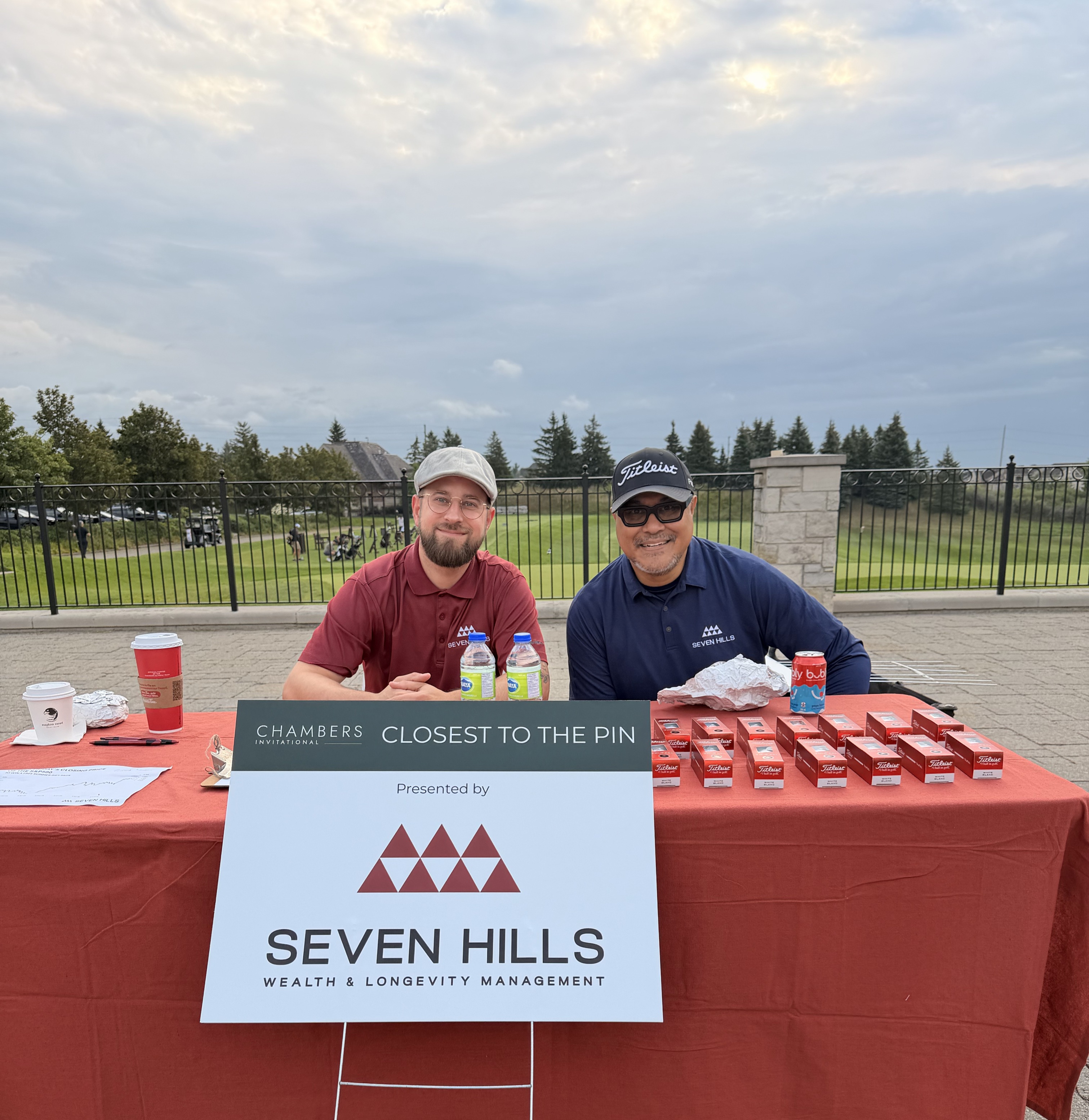
On August 19th, Grant Laschowski and Chris Nunes joined 28 young Bay Street lawyers and other professionals at Eagles Nest Golf Club for the inaugural Chambers Invitational, organized by Michael Lee and Zachary Soccio-Marandola in support of SickKids Foundation.
The tournament raised more than $4,000 in its first year, but what stood out to us was the initiative behind it. Zach, who underwent two open-heart surgeries before the age of 18, was joined by several other former SickKids patients. After the round, some shared their stories over lunch — a powerful reminder of the extraordinary impact SickKids has had on so many children and families.
Mike and Zach deserve tremendous credit for bringing their peers together and turning an idea into action. Many of those who participated are friends and professional partners of Seven Hills, and we were delighted to support them in their inaugural year. We hope to play an even more meaningful role in the years ahead.
There is also a lesson in what they started. Meaningful things rarely begin at scale. Someone takes the first step, others join in, and momentum builds. Mike and Zach took that first step this year. With the continued support of their friends, colleagues and community, we suspect the impact of the Chambers Invitational will compound for many years to come.
It was a busy summer at Seven Hills. We welcomed a number of new client families since the last letter, and for some of you this is the first edition of Client Matters to land in your inbox. Welcome. We are grateful you are here, and I hope these letters read the way they are intended: one person writing plainly to the people he works for.
One more story from the fast water, because it involves people we care about.
Betterment surveyed American retail investors this spring and found something that should get our attention. Among Gen Z investors, 26 percent describe sports betting as a deliberate part of their long term financial strategy. More than half said they had redirected money intended for investing into sports betting during the previous year. And 60 percent cite social media as a source of financial news, compared with just 21 percent who cite a financial adviser.
Before anyone reaches for outrage, look at the arithmetic instead. Researchers from the University of Toronto, HEC Montréal and ESSEC studied more than 1.4 million users and $20 billion of trading volume on Polymarket, one of the largest prediction market platforms. Roughly 69 percent of users lost money, and the top one percent captured about three quarters of all the profits.
Read those two numbers again. Seven people in ten lost. One person in a hundred took three quarters of the gains. The product sells urgency extraordinarily well, particularly to people who already feel behind. And the compounding of loss is every bit as powerful as the compounding of gains.
Here is the hopeful part. The young people we work with, many of them children of our clients, do not have to become this story. Some started with me years ago with small amounts and a polite disbelief that seven or eight percent a year could ever turn small money into real money. Then they watched the math do what the math does. Quietly, on its own schedule.
Roger Federer explained this beautifully in a commencement address at Dartmouth. Across the 1,526 singles matches of his career, Federer won almost eighty percent of his matches. But he won only 54 percent of the points.
One of the greatest tennis players who ever lived lost almost every second point he played.
That slim majority, repeated patiently across a career, became greatness. You do not need to win every point. You do not need the biggest swing. You do not need to make up for yesterday by doubling down today. You need to win a small majority of the moments, over and over, and refuse to let the ones you lose change the way you play the next one.
So consider this an open door rather than a lecture. If a young person you love is feeling behind, or believes the way out of a hole is a bigger swing, we will gladly sit down with them. No minimums for a conversation. No judgment. Just the arithmetic and a head start. Helping the next generation of the families we serve has never been a side project for us.
The same season that has investors taking a fresh look at their portfolios has most of us taking a fresh look at ourselves. New notebooks. New routines. Resolutions that are somehow easier to keep in September than in January. Good. Here are the only two questions I would bring to the project.
The first: how would your future self feel about what you are doing today? Not your future portfolio. Your future self. The one who either can or cannot carry a grandchild up the stairs. I find this question does more work than any gadget or dashboard because it is a compass rather than a scoreboard. You consult a compass and correct course. You do not refresh it eleven times a day.
Life is short, and the end of it creeps up more quickly than almost anyone expects. Too many people meet their future self only at the very end, and the meeting is full of wishes: that they had done more, moved more, taken better care. Do not let that be you. The remedy is not dramatic. It is one ordinary day, looked after, and then another.
The second comes from doctors I trust, who are watching a strange new affliction among people who can afford almost anything: measuring everything and improving nothing. Hundreds of biomarkers and no stopping rule. Their advice is remarkably similar to the asset mix discipline we preach here. Build the foundation first. The foundational pieces have not changed and they never will: sleep, nutrition, exercise and relationships. Last month I wrote about caring for something, and that is the relationships piece doing its quiet work. There is no pill, no clinic and no treatment that can match the daily benefit of getting those four right, and until the foundation is in place, a hundred numbers are mostly noise. Test what matters. Interpret it in context. Retest at a date you set in advance. And in between, live your life.
A crash diet in January and chasing an asset after it has already run are the same decision expressed in different currencies. Both try to compress a decade of patience into a month of intensity.
And when discipline wobbles, here is the picture I come back to. Life is a relay, and the legs are days. Every morning you take a handoff, and the runner passing you the baton is you, yesterday. You know exactly what you would want from the runner ahead of you in a real relay: that they gave their leg what they had, so the baton arrives with you in the best possible position. Well, you are that runner every single day for the person you will be tomorrow. No single leg has to be heroic. It only has to be run with the next runner in mind.
And the next runner is you.
I will close with blueberries. They followed me through August. Early in the month I visited an abandoned airfield in Algonquin Park with my friend Pete. Acres of wild blueberry bushes, and some of the best handfuls I have ever tasted. We went hoping to see bears, which never happened. The berries more than made up for it. Later in the month it was those bushes beside the lunch rock on the French River, fruiting out of cracks in the Canadian Shield, planted by no one.
Then I built a patch of my own at home, in a difficult spot near the water. I cleared the brush, moved what rock could be moved, hauled driftwood up from the shore to frame the beds, and planted bushes that, to my genuine surprise, took and fruited in their first season. Nobody watched me do the clearing.
And the clearing was the whole project.
The berries are gone now. The roots are deeper. Next year the bushes will pollinate one another and, if I have done the work properly, the yield will grow. That is this firm's entire philosophy, planted in dirt: prepare the ground, stay patient, and let the roots work quietly while the river hurries past.
So, can you believe how fast summer went? I can. Eight weeks, the same as every year. But gone is not lost. The season did its work. The roots went deeper. And the moon over the lake came out of the Earth's shadow exactly as it entered it.
September was never the end of anything.
It is the true start of the year.
And we intend to start it well. By the time you read this I will be away for a week with my family, doing what summer was too busy for: sitting on rocks that hold no opinion on interest rates. The portfolios will not miss me. They were built so they would not have to.
As always, the best part of my job is speaking with you. Please feel free to reach out anytime.
Warmly,
Patrick Keeley
Seven Hills Capital Corp.
2 St. Clair Avenue W. | Toronto | Canada
Wealth is not just about what you have, but how you live.
This material is for informational purposes only and should not be construed as investment advice or a recommendation to buy or sell any security. Past performance is not indicative of future results. Please consult with your Seven Hills advisor before making investment decisions.