I hope this letter finds you deep into a good summer, caught up with the people you kept meaning to see all winter and finally getting to the things that waited for warm weather. That is what these months are for.
Which is why the wildfire smoke felt like such a theft. Most of us dealt with something this summer that we are not at all used to: the air itself turning against us. Whether you were in Canada or the United States, there were days when the sky went orange, then a strange sour yellow, and everything smelled like a campfire nobody lit on purpose. Gord, who has never once declined an invitation to go outside, stood at the door and reconsidered. So did I.
What struck me most was how differently people responded. Some got angry, because inconvenience always goes looking for someone to blame. Others got on planes. Firefighters did what they have always done, crossing borders to help one another. Crews from Canada, the United States, and around the world have long answered each other's calls, because disasters do not recognize maps. The smoke, for its part, never checked a single passport.
That is where humility begins. The fires reminded us of how little we control, and how much depends on what we do with the part we cannot.
A few things have happened lately that I have seen play out many times across my career, and looking back now they turn out to be some of the most informative sound bites for us as an asset mix committee here at Seven Hills. In each case, the reason people reached out was the same: They had reached a boiling point, that moment when you simply cannot take it anymore and all that pent up energy tells you it is time to jump on the bandwagon.
In late January, several of you wanted more gold and silver, both climbing beautifully, and beautiful performance is very persuasive. Both have since fallen hard. In late March, a few of you wanted the opposite, to sell everything and go to cash because the world felt like it was ending. That week was close to the bottom. Then in early July, as the headlines filled with the AI buildout, the question became why we own anything else. You have seen what those darlings have done since.
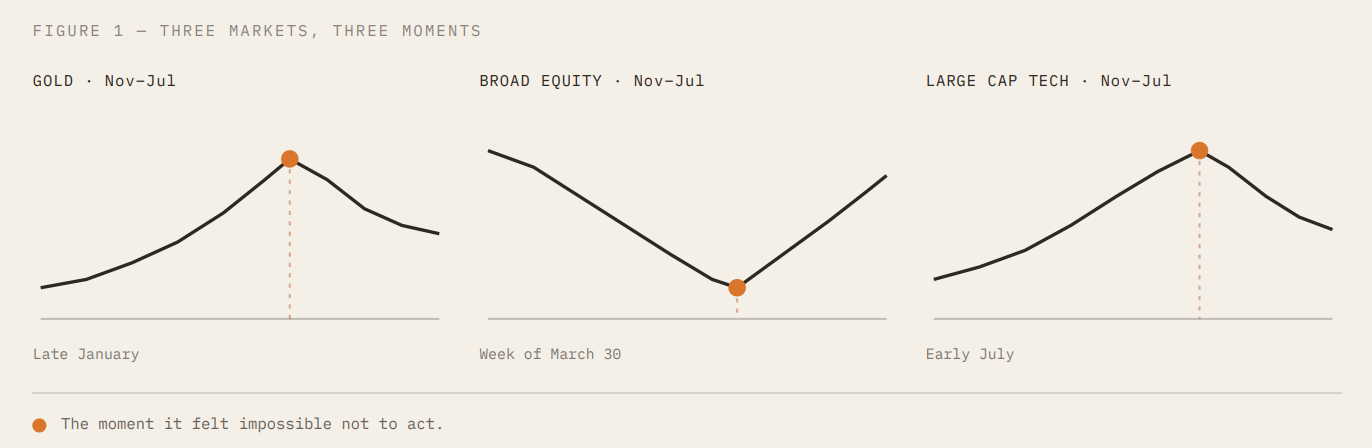
Please hear this the way I mean it, because I live inside this pattern too. Look at those three moments with the benefit of hindsight. Every one was the wrong time.
What feels like urgency, that boiling point when everyone reaches it at once, is almost always the wrong time to act.
There is a name for the feeling underneath all three. It is the fear of missing out, and it quietly trades the good you already hold for a highlight reel of what someone else seems to be having. The antidote, unglamorous as ever, is gratitude. And here comes my shameless pitch for it. Gratitude is not just good for your soul. Researchers have linked it to lower blood pressure, a stronger immune system, and a meaningfully lower risk of dying from any cause. Studies from the Harvard Kennedy School even found that people high in gratitude make measurably better financial decisions. The most successful investors are rarely the ones chasing the next thing. They are the ones quietly content with what they already own, and they may just live longer to enjoy it.
One more observation on those AI darlings, because it matters. My worry was never really the valuations. It was the velocity, the sheer speed of the climb, which is the texture of every bubble I have observed, and speed like that borrows from the future. There is plainer arithmetic underneath it too. When trillions are committed at once, a meaningful share of those bets will prove wrong. That is not pessimism, it is how large numbers behave. And something remarkable happened these last few weeks. Companies reported genuinely strong results, in some cases record profits, and the market stopped applauding. When good news stops lifting prices, the news was never really the point.
The price was.
We went into this year carrying an overweight position in large cap technology stocks, the very ones making all the headlines. As the run grew louder, we did the unglamorous thing. We trimmed, took the profits, and moved them toward businesses the crowd had grown bored of.
This is reversion to the mean, one of the oldest gravities in finance. Prices stretched far above their worth get pulled back, and good companies left below their worth for too long get rewarded. The market spends most of its time overpaying for excitement and underpaying for patience. Our job is to stand on the other side of that trade, quietly, before it is obvious. We do not follow the pack, and we are comfortable being early and a little lonely rather than late and comfortable.
Nowhere does that matter more right now than in bonds. For a generation they were the reliable airbag, the thing you owned for certainty. That contract is quietly being rewritten. The world's appetite for lending endlessly to large governments is no longer automatic, and when the safe asset stops feeling entirely safe, you cannot simply keep doing what worked and hope. So we are looking elsewhere for the ballast bonds used to provide. It is not simple work, and we are energized by it. Finding steadiness in unfashionable places is exactly the work we signed up for.
Now let me be specific about something that sits underneath a lot of your portfolios right now, and underneath the whole economy. I am talking about the price of oil.
When conflict broke out in the Middle East at the end of February, the people who started it told the world it would be over in four or five weeks. That deadline came and went, yet the talking heads kept baking a quick and tidy ending into their forecasts, and the large global institutions built their numbers around the disruption fading by spring. Here we are five months on. It has widened rather than faded. A ceasefire came and then broke. The single most important shipping lane for oil on earth has spent much of this period restricted, which the world's energy watchdog has called the largest supply disruption in the history of the oil market. Oil that recently traded in the sixties now sits close to one hundred dollars a barrel, and the strain reaches well beyond the crude itself, into diesel, jet fuel, and the petrochemicals that quietly sit inside almost everything we buy.
We read this differently than the crowd, and we still do. We do not believe this ends cleanly or soon, and we do not believe oil simply returns to flowing the way it did before that February morning. So we added to our energy exposure deliberately, while the comfortable view was still that it would all blow over.
There is a wrinkle worth knowing, too, and it puzzled me for months. For long stretches of the war, oil prices actually fell, which made no sense with supply this tight. Part of the answer, it turns out, is China. As the world's largest oil importer, it quietly took its foot off the accelerator, choosing to live off the vast stockpiles it had built before the war rather than buy into a strained market, perhaps betting the conflict would be brief. That restraint held prices down and fed the calm. But the war has dragged on, those stockpiles have been draining, and China will have little choice but to return to the market to rebuild them, adding fresh demand at exactly the wrong moment. The United States faces the same pressure, with its own strategic reserve sitting near its lowest level since 1983. Two of the largest buyers on earth may soon be refilling at once.
Let me be careful what we take credit for. We did not forecast a war, and we take no pleasure in the reasons behind these prices. We simply read the situation more soberly than the optimists, noticed that supply was genuinely tight, and saw that certainty about cheap energy was everywhere. Certainty like that is usually cheap to bet against.
Now let me connect it, because the price of oil is never really about oil alone. When it stays high, it seeps into almost everything. It is the airline ticket, because jet fuel is the single largest cost of a flight. It is the price of food, because nearly everything you eat travels a long way on a truck before it reaches you. It is the cost at the pump, the most visible of all. Oil is an input into a staggering share of daily life, so when it rises and stays risen, the result is broad and stubborn inflation.
Here is what concerns me most, and it is where my thinking began this year. At the very moment oil is pushing prices up, interest rates are rising too. That is a genuine problem, and not only for the Federal Reserve. For decades the United States could count on the rest of the world lining up to lend it money, buying its government bonds almost without question. That appetite is quietly fading. Some of it is sentiment, a cooler feeling toward America that surfaced loudly last spring and has returned in quieter, more structural ways. Some of it is simpler still, fewer foreign buyers for the bonds, fewer visitors even traveling there. When the world's steadiest borrower has to work harder to find lenders, the price of borrowing goes up for everyone.
So we have two headwinds arriving together, costlier energy and costlier money, and both pressed on the same place, the economy and the consumer who carries it. Push hard enough for long enough and you eventually get what economists call demand destruction. People stop buying, activity slows, the economy cools. The irony is that this can become its own cure, because a slowing economy is often met, in time, with lower interest rates meant to coax activity back to life.
That full circle, from tight energy to higher rates to a slowdown to eventual relief, is the lens through which we are watching the world and managing your money this year. We hold our views with humility, because nobody is certain of anything in markets. But we are certain of how we are approaching this, and we are confident in the process we follow. Our portfolios are built for this sequence of events, not for the world the talking heads keep promising.
Urgent is the smoke in the sky, the headline, the itch to act on whatever moved most recently.
What matters is the plan built before the smoke arrived, a portfolio that does not need us to be right about the next six months, and the discipline to question our own strongest feelings, especially at the moment everyone around us shares them.
None of this happens in a vacuum. Behind every line of this letter is a team meeting often as our asset mix committee, weighing these very questions and deciding what belongs in your portfolio and what no longer does. But managing your investments is only ever part of the picture. We have spent much of the past few weeks with accountants, lawyers, and other firms whose work touches yours, some who already look after people we serve, others we sought out simply because we believe they could make your life better. We think of ourselves as one member of a team assembled around your whole life capital, not merely the money, but the health, the family, the plans, and the peace of mind that money is meant to protect. Our job is often to quarterback that team, and to keep looking, always, for a way to serve you better than we did last year.
Most of you know me well enough to know that health and wealth have never been separate things in my mind, and those of you who have read my notes over the years have seen me weave in ideas on living longer and better. It is too hardwired into me to leave out. So here is my promise: I will not overwhelm you, but I hope you will indulge me one small idea each month, all in service of your whole life capital.
Here is this month's, wrapped in good news:
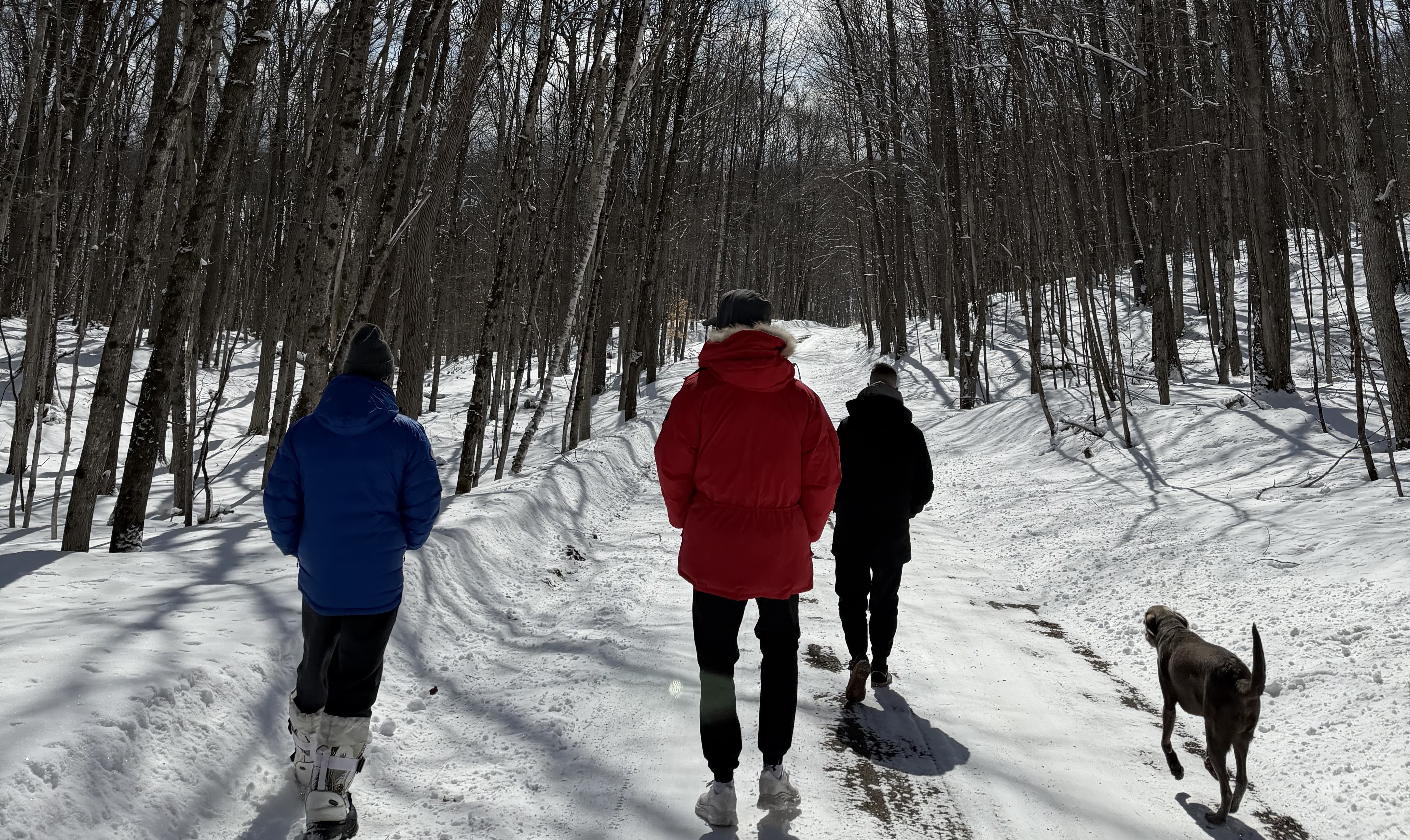
Caring for something turns out to be one of the quietest longevity strategies we know of. Research published by the American Heart Association links owning a dog to a lower risk of dying from just about any cause, and the researchers are clear it is not the walking that does it. It is the caring, the simple fact that something depends on you. Gord, asleep at my feet as I write this and contributing absolutely nothing to the economy, will be delighted to learn he may be extending my life.
Gardeners, you are covered too. One well known study found that nursing home residents given a plant to tend, rather than one the staff cared for, grew healthier and more alert. The plant was not magic. The responsibility was. There is even a spiritual cousin to this. People with an active faith or spiritual practice have been shown, across several large studies, to live a number of years longer than those without one.
So consider this your permission slip. It is still growing season. If you planted something this spring, I hope you are eating it by now. And if you have no dog, no garden, and no one in your care, perhaps that is the thing worth changing. Get the plant. Adopt the dog. Call the person who needs calling. Your blood pressure, and quite possibly your calendar of years, will thank you.
Over these past weeks a number of wonderful new families have joined us, and if you are reading this letter for the first time, welcome. You have joined a community more than a client list. To those who have been here for years and sent these new friends our way, thank you. That trust is the whole of our reputation, and we do not take a bit of it for granted.
I will leave you where the week left me.
The smoke rolled back into Muskoka last night, gentler this time, but enough to yellow the sky. And there was the moon, all but full, hanging low and orange behind the haze. July's is the Buck Moon, named for the new antlers on the deer. The forest's own moon, dimmed by the forest's own fire.
It struck me that this same moon hung over every moment in this letter. The January certainty, the March despair, the July frenzy. It watched all of it, cared for none of it, and simply rose, the way it always has and always will.
That, in the end, is the whole job. Not to predict which way the smoke will blow.
Just to be the kind of team that can look up at an orange moon, feel honestly small, and still sleep well, because the plan was made long before the smoke came, and because nobody here is standing under that sky alone.
As always, the best part of my job is speaking with you. Please feel free to reach out anytime.
Warmly,
Patrick Keeley
Seven Hills Capital Corp.
2 St. Clair Avenue W. | Toronto | Canada
Wealth is not just about what you have, but how you live.
This material is for informational purposes only and should not be construed as investment advice or a recommendation to buy or sell any security. Past performance is not indicative of future results. Please consult with your Seven Hills advisor before making investment decisions.